AI-Assisted Grading
AI-based feature increases efficiency of grading without sacrificing valuable student feedback
Summary

Mission
Labflow (a Catalyst Learning product) realized that instructors were spending a significant amount of time grading student lab reports, which often required support from teaching assistants and led to grading inconsistencies. To address these problems, they introduced AI-Assisted Grading, which allowed instructors to enable automated grading for eligible questions.
My contributions
As the lead designer on this effort, I focused on striking the right balance between support and empowerment: using AI to meaningfully reduce grading effort without removing instructor agency, obscuring confidence levels, or undermining academic integrity.
Kickoff
Defining a vision
We partnered closely with the Labflow team to help define a clear, future-facing vision for AI-based features across the product suite. Building on Labflow’s strong, trust-based relationship with instructors, we aligned early on the principle that AI should enhance (not replace) human judgment. This vision intentionally placed instructors in the driver’s seat of every workflow, ensuring that AI would act as a supportive, transparent assistant rather than an automated decision-maker.
By anchoring the project in this shared philosophy from the outset, we established guardrails that informed product strategy, interaction design, and system behavior throughout development, and created a foundation for scalable, user-centered AI experiences as Labflow continues to evolve.
Challenges
We wanted to ensure we clearly understood instructor’s concerns by conducting interviews with a sample of seven instructors. Research revealed that instructors worried about over-automation and loss of pedagogical control. They also worries that their TA's might rely too heavily on AI for grading, or that AI outputs could appear definitive even when confidence in a grading result was low. AI features risked feeling opaque or inconsistent across Labflow products.
The challenge was not simply designing an AI feature, but designing clear boundaries, transparency, and trust into the grading workflow.
Design
Exploration
A unique challenge we faced with this project involved understanding technical constraints and limitations of the automated report grading. Labflow is an advanced and complex product built with power users in mind. In order to address this, we began by listing all of our questions and assumptions to discuss with the Catalyst team to ensure we had a deep understanding before diving into design.
Through a few rounds of design iteration, we were able to find harmony in a design that addressed instructor's concerns, could be implemented easily and intuitively into the existing product, and allowed users to find the right level of control for their grading process.
Key decisions
AI as an advisor, not authority
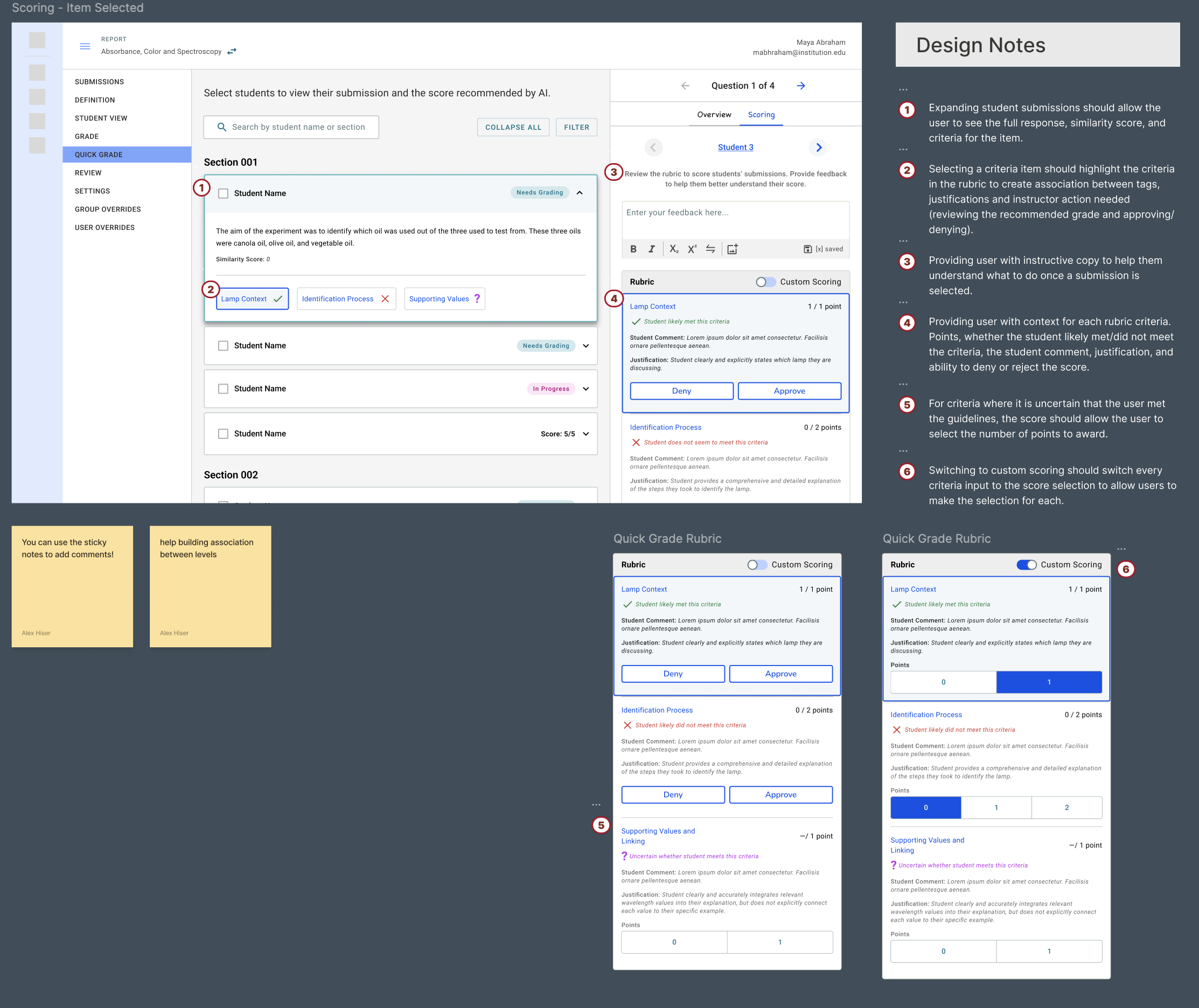

Rather than allowing AI to automatically grade student submissions, we designed the system to provide recommendations for each rubric criterion, require instructors to approve or override the assessment and provide a clear rationale for each recommendation. We also designed the system to explicitly state whether the AI had enough data to confidently provide a recommendation, and when the AI lacked confidence, instructors were asked to make the final call, which reinforced trust and accountability.
Course-level controls to protect academic integrity
To prevent over-reliance on AI grading, we introduced course-level controls for AI-Assisted Grading. This allowed instructors to set expectations for when AI assistance was appropriate, maintain consistency across grading teams, and reinforce that AI was a tool (not a default shortcut). This decision directly addressed concerns raised in interviews about misuse and pedagogical drift.
Editable and regenerable rubric criteria
Recognizing that AI-generated rubrics would rarely be “perfect,” we designed editing tools that allowed instructors to review and refine generated criteria, regenerate criteria when prompts or expectations changed and fully override AI suggestions with manual inputs. This reinforced a sense of ownership and aligned the system with instructors’ existing mental models of grading.
Consistent branding of AI features
To avoid confusion and build recognition, I helped define a product-wide AI design language, including distinct iconography and color treatments, systematic tagging of AI-assisted elements and clear labeling that differentiated AI recommendations from instructor decisions. This ensured instructors could quickly identify when AI was involved without needing to second-guess system behavior.
Ability to revert to manual grading
At any point, instructors could revert to manual grading, which would supersede AI recommendations. This removed AI influence from the workflow and reinforced trust during edge cases or high-stakes assessments. Rather than treating manual grading as a fallback, we intentionally designed it as an equal, respected path.
Outcomes
Impact
This project resulted in a major success for instructors and the Catalyst team. For instructors, AI-assisted grading reduced grading effort while maintaining instructor confidence and consistency in grading. For Catalyst, this feature established a scalable and ethical standard for AI-assisted workflows, increased instructor trust by prioritizing transparency and control, and created a reusable design framework for future AI features.
Reflection
This project reinforced that designing AI features is less about automation of key workflows and more about intentional integration to help instructors make informed decisions. By clearly defining what AI could (and could not) do, we created a system that respected instructors’ expertise while still delivering meaningful assistance.The result was not just a feature, but a design philosophy for AI-assisted tools grounded in trust, clarity, and human judgment.

